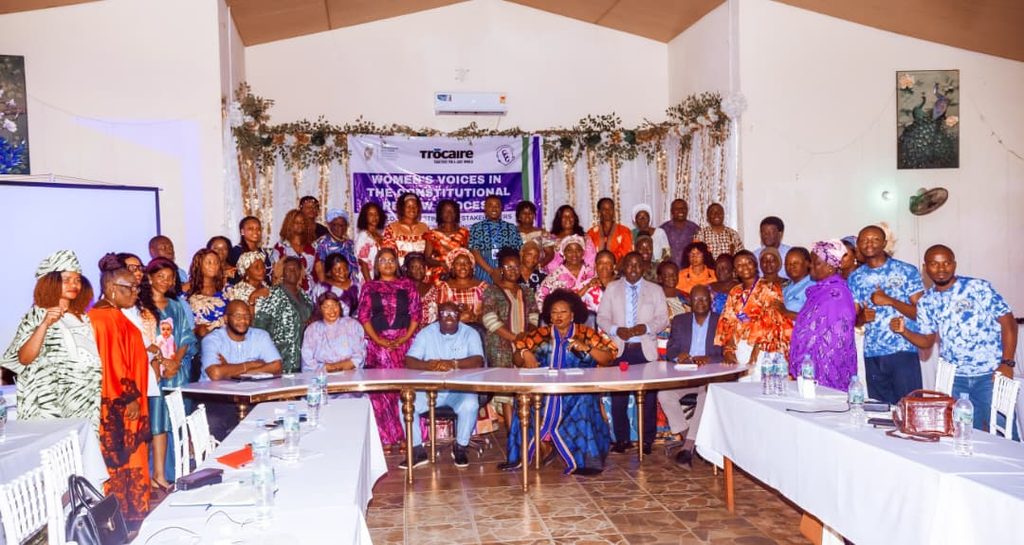
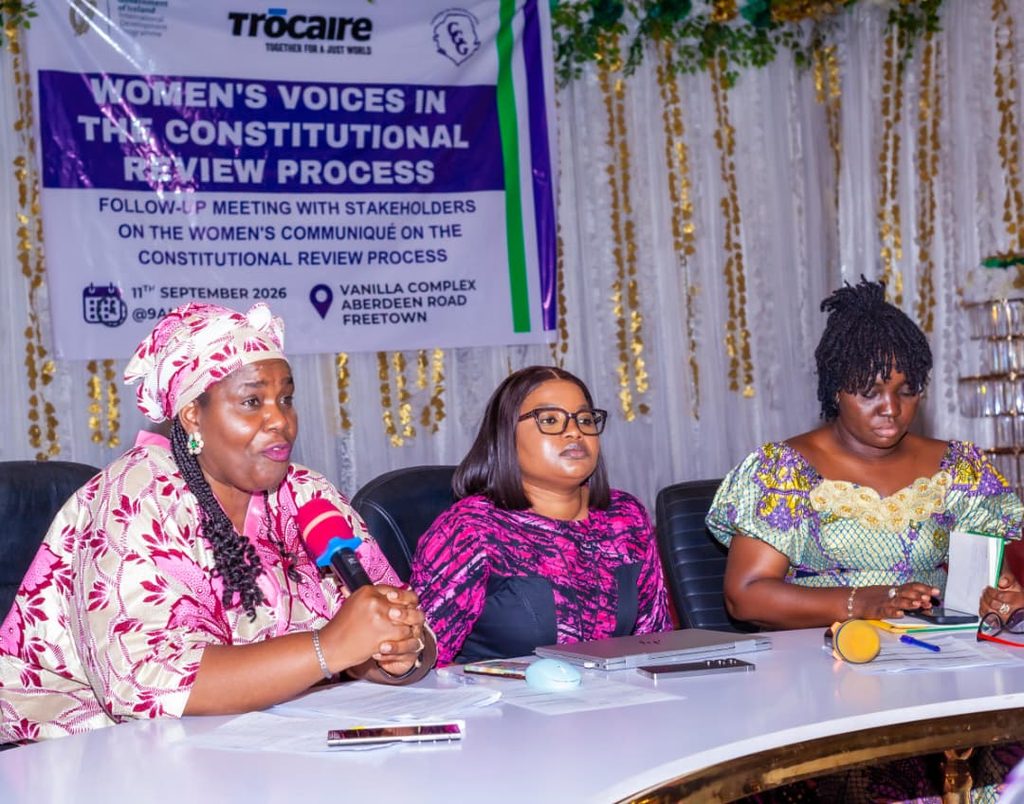
The Network of Women Ministers and Parliamentarians (NeWMaP) was among the key stakeholders invited to participate in the National Women’s Conference on the Constitutional Review Process, convened by the Campaign for Good Governance (CGG) in collaboration with partners under its National Advocacy for Women’s Empowerment (NAWE) initiative, with support from Trócaire/Irish Aid.
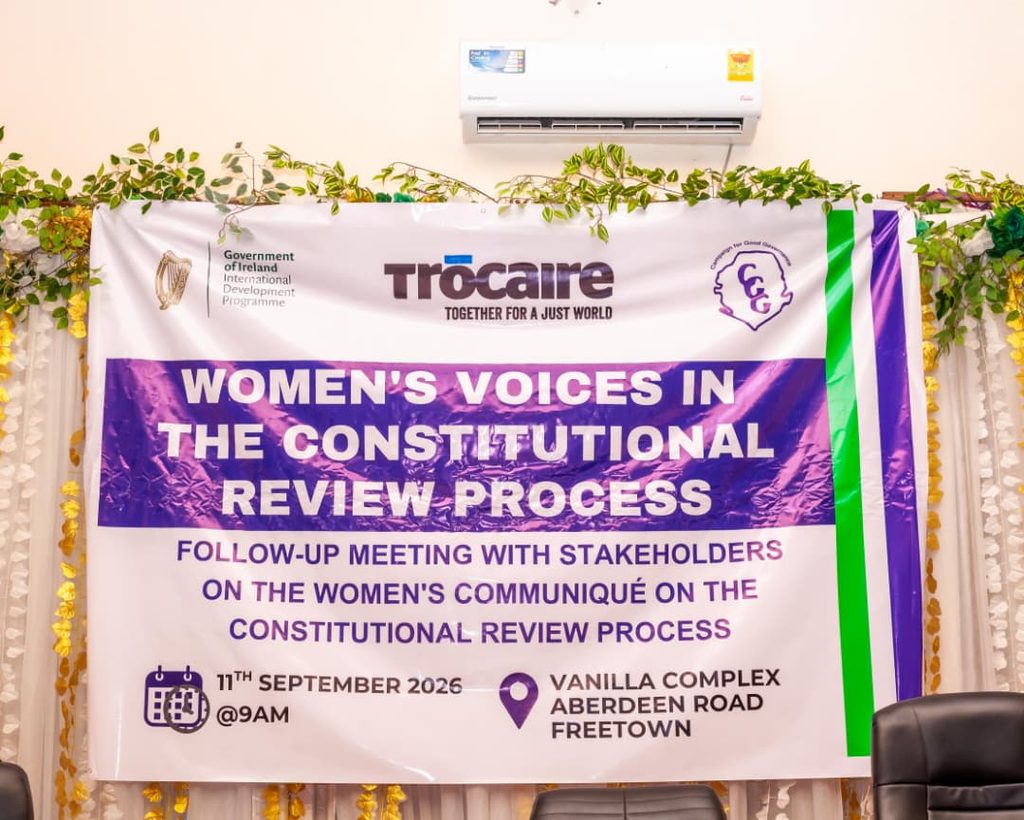
Held on 11 September 2026 at the Vanilla Complex, Aberdeen, Freetown, the conference brought together women leaders and stakeholders from all 16 districts of Sierra Leone to examine outstanding issues in the constitutional review process, with particular focus on women’s political representation, equality, participation in governance, and ensuring that women’s recommendations are reflected in constitutional reforms. The conference was chaired by Mrs. Marcella Samba Sesay, Executive Director of CGG.
Only seven of approximately 80 participants indicated familiarity with the content of the Constitutional Amendment Bill 2025 — a finding that highlighted a significant information gap and reinforced the need for continued civic education and public awareness. Mr. Sahr Kendema, Senior Programs Manager at CGG, encouraged women to remain actively engaged and to cascade the knowledge gained to community, district, regional and national levels.
Mr. Ibrahim Bangura Esq., Governance Expert, delivered a comprehensive presentation on the content and process of the Constitutional Amendment Bill, covering historical milestones from the Peter Tucker review process through the Cowan Constitutional Review Commission, the 2017 and 2021 Government White Papers, the 2023 Agreement for National Unity, the 2024 Tripartite Report, and the current amendment process. He examined women’s nominations, Proportional Representation (PR), First-Past-the-Post (FPTP), presidential elections, fixed election dates, independent candidacy, executive transition, security-sector neutrality, and the composition and appointment of electoral institutions, emphasising the distinction between nomination and representation: Nominated → Electable → Elected → Represented.
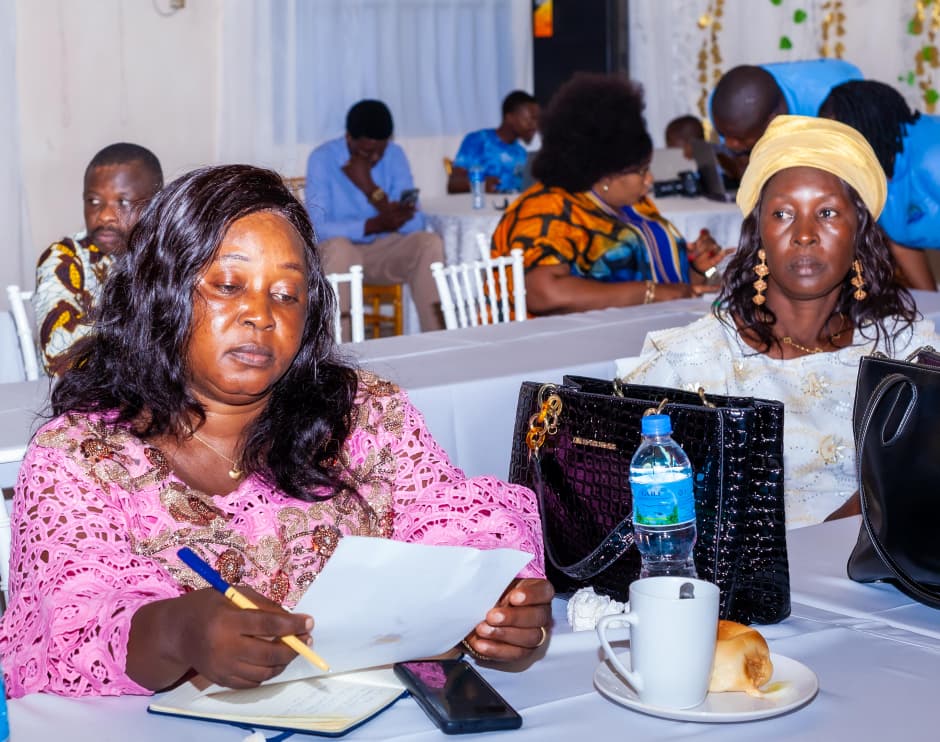
Statements by Key Stakeholders
Madam Fatimah M.D. Momodu, speaking for the All-Political Parties’ Women’s Associations (APPWA), challenged women to reflect on how they support other women seeking leadership, and called on political parties to create greater opportunities for women under both PR and FPTP systems.
Mr. George Were, Country Director of Trócaire, commended CGG for convening the dialogue and reaffirmed Trócaire’s commitment to advancing gender equality and women’s rights in Sierra Leone.
Mr. Charles Vandi, Chief Director at the Ministry of Gender and Children’s Affairs, encouraged stakeholders to use social media and other platforms to broaden public awareness, and stressed women’s economic empowerment and accountability throughout the reform process.
Roundtable Discussion and Key Contributions
Haja Marie Bob-Kandeh (President, Sierra Leone Market Women’s Associations) reflected on her participation in the Peter Tucker process, discussed the “zipper” approach to representation, and recommended regional-level engagements.
Ms. Menisa Sesay (President, Legal Access through Women’s Yearnings for Equality, Rights and Social Justice) expressed concern that the proposed amendment emphasises electoral matters without sufficiently addressing a comprehensive gender-sensitive constitutional framework, highlighting Sections 27(4)(d) and (e).
Hon. Rose Marie Bangura, MP, encouraged participants to move beyond party considerations, discussed the GEWE Act 2022, dual citizenship and sustainable empowerment, and recommended cascading the conversation to communities and amplifying the 16 recommendations on women’s issues.
Hon. Rebecca Yei-Kamara, MP, highlighted legislative developments including the Sexual Offences Act, GEWE Act and Customary Land Rights Act, and addressed dual citizenship, independent candidacy, parliamentary eligibility, replacement arrangements for women elected through quota mechanisms, party symbols for women candidates, and public education on PR calculations.
Ms. Millicent Kargbo (President, Sierra Leone Association of Women in Journalism) highlighted structural barriers to women’s leadership and called for political will, economic empowerment and protection from violence against women, including online violence, recommending town hall meetings and documentation of key commitments.
Ms. Valnora Edwin (President, 50/50 Group Sierra Leone) encouraged organisations to cascade knowledge to communities, urged women with media access to educate the public, and emphasised socio-economic empowerment and advocacy content capable of shaping public understanding.
Consolidated Key Calls and Recommendations
1. Release of the Final Reviewed Constitution — to enable women and other stakeholders to assess the incorporation of women’s priority issues before the referendum.
2. Strengthened Civic Education — intensified, accessible public awareness, particularly for grassroots women.
3. Stronger Political Commitment — from political parties and government institutions to women’s representation and leadership.
4. Continued Engagement with Political Parties — at national and district levels.
5. Greater Inclusion of Women with Disabilities and Marginalized Groups — to ensure inclusive and responsive reform.
6. Economic Empowerment and Protection from Violence — including online violence.
7. Broader National Engagement — extending discussions to traditional leaders, youth, media, civil society and grassroots women’s organizations.
8. Sustained Advocacy on the National Women’s Communiqué — amplifying, monitoring and advancing the women’s recommendations.
9. Stronger Multi-Stakeholder Collaboration — across civil society, women’s groups, political parties, government, electoral stakeholders, traditional leaders, youth and media.
10. Sustained Rather Than One-Off Engagements — continuous advocacy throughout the reform process to support monitoring, accountability and follow-up.
NeWMaP’s participation in this national convening underscores its commitment to amplifying women’s voices and ensuring that women’s leadership, equality and representation remain central to Sierra Leone’s constitutional reform agenda.